Palletizer safety: How to assess risk and meet ISO 10218:2025 standards
Learn how to assess palletizer safety, perform risk evaluations, and meet ISO 10218:2025 standards for safe, efficient robotic palletizing.
Automated palletizing makes production safer and more efficient. It reduces manual strain and improves output. But every system still has moving parts and heavy loads. When safety steps are skipped or misunderstood, people get hurt.
For years, palletizer safety focused on two things: certified robots and physical guards. The new ISO 10218:2025 standards show a different approach.
A certified robot doesn't guarantee a safe system. Safety comes from how the robot fits with your tooling, conveyors, and workspace.
This means the same robot can be safe in one setup and dangerous in another. It all depends on your specific layout and how you use it.
This guide shows you how to assess palletizer safety using this approach. You'll learn about key standards, risk assessments, and collaborative technologies that make automation safer from setup to daily operation.
Key Safety Standards for Palletizing Applications
For years, the industry treated robot safety as a robot problem. Buy a certified robot, add some guarding, call it done.
But ISO 10218:2025 represents a fundamental shift. Safety is no longer just about the robot. It's about how the robot, tooling, conveyors, and workspace work together in your specific facility.
These global and regional standards form the foundation for building and operating palletizing systems that are both productive and safe.
Core Standards You Need to Know
ISO 10218-1:2025 and ISO 10218-2:2025
Robots and Robotic Devices: Safety Requirements for Industrial Robots
This standard defines safety for the full application, not the robot alone. Part 1 covers manufacturer design requirements. Part 2 guides integrators on safe installation and validation. It incorporates collaborative safety principles from ISO/TS 15066 and recognizes that safety devices are often required even for collaborative applications.
ANSI/RIA R15.06 (2020)
Industrial Robots and Robot Systems – Safety Requirements
The U.S. version of ISO 10218, guiding manufacturers, integrators, and users in safe design, installation, and operation of robotic systems.
CSA Z434-14 (2024)
Industrial Robots and Robot Systems: Safety Requirements (Canada)
Canada's equivalent to ISO 10218, aligned with the 2025 updates. It emphasizes collaborative applications and clarifies shared responsibilities between suppliers, integrators, and users.
Every TOMA™ palletizer from Premier Tech is developed and validated according to these standards. Each system complies with ISO 10218:2025 and is verified for safe collaborative operation up to 650 mm/s. The maximum contact force is limited to 130 N, staying safely below the 140 N threshold defined in the standard.
However, compliance at the factory doesn’t guarantee automatic safety in your facility. Each application must still be reviewed to confirm that the system’s speed, layout, and environment meet your site-specific safety requirements.
Performing Palletizing Application Risk Assessment
A risk assessment is required before any palletizing system goes live. It's not optional. Standards mandate it, and worker protection depends on it.
This isn't a generic checklist you download and check off. It's a structured review of how the system will actually operate in your facility: your layout, your speeds, your workflows, your people.
If you're responsible for safety decisions but aren't a safety engineer, this can feel overwhelming. The standards use technical language. They assume expertise. And every facility is different, so generic guidance doesn't account for your specific setup.
That's normal. The assessment process is designed to walk you through it systematically.
What the Assessment Examines
The goal is simple: identify where someone could get hurt, then decide how to prevent or reduce that risk.
Payload weight and inertia
Heavier loads and faster movements carry more energy. This increases injury risk, especially with short stopping distances or abrupt direction changes.
Object shape and material
Sharp or rigid parts may require slower speeds or extra guarding to limit contact forces.
Robot speed and range of motion
Greater reach and higher speed raise risk, especially where people may enter the palletizing zone.
Operator access patterns during normal operation
Tasks like changing pallets, clearing jams, or adjusting sensors are moments of highest exposure. These must be reviewed closely.
Non-routine access during maintenance and troubleshooting
Planned production cycles are predictable. Maintenance and troubleshooting often involve unplanned risks that need separate safety procedures.
How This Applies to TOMA™ Systems
Premier Tech validates collaborative performance up to 650 mm/s for TOMA™ palletizers. The systems are pre-configured for safety. But the final review must confirm that this speed suits your space and safety requirements.
Every facility operates differently. The risk assessment helps identify where the standard configuration works and where additional safeguards may be needed.
What’s Different With Collaborative Palletizing Applications
You've probably heard that collaborative robots are "safe by design." You may have also heard stories that make you cautious about removing guards. Both perspectives have merit.
Collaborative palletizing systems have real safety features built in, but they're not automatically safe in every application. Every system still requires a risk assessment to confirm it works safely for your specific layout, speed, and payload.
What Makes Collaborative Systems Different
Collaborative palletizing applications using TOMA™ solutions let people and automation work closer together without compromising protection or performance. Because they often require less physical guarding, they're ideal for facilities with limited space or where flexibility is a priority.
But "less guarding" doesn't mean "no safety measures." It means safety is built into the system differently.
Technologies That Enable Human-Robot Collaboration
Several technologies make it possible for people to work near palletizing robots. Here's how TOMA™ implements each one:
FLX-0830 Safety Kit
Extends safe operation beyond standard collaborative limits.
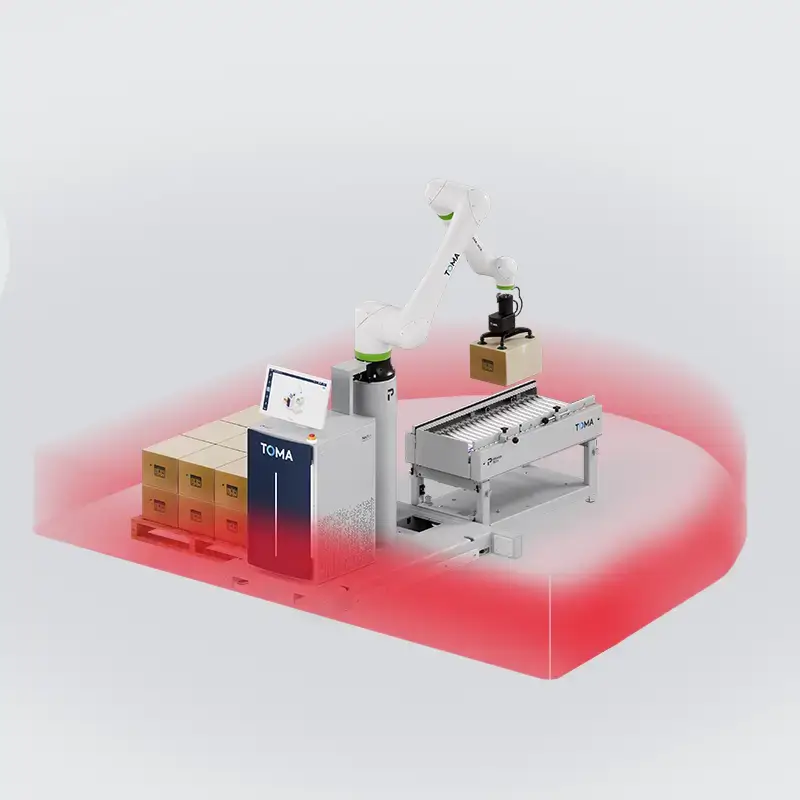
This plug-and-play kit adds portable, anchor-less guarding, virtual front barriers, and automatic speed control. It reduces motion from 1000 mm/s to 650 mm/s when access is detected. It also includes resume and emergency-stop buttons on each side and arrives fully preconfigured for quick deployment.
The FLX-0830 can be integrated in minutes and moved easily between palletizing setups. It allows TOMA™ to run up to 1000 mm/s under normal operation and automatically slows to 650 mm/s when a person enters the protected zone. This balance of productivity and protection lets facilities maintain throughput while staying compliant with ISO 10218:2025 safety requirements.
Power and Force Limiting (PFL)
Sensors detect unexpected contact and stop motion automatically.
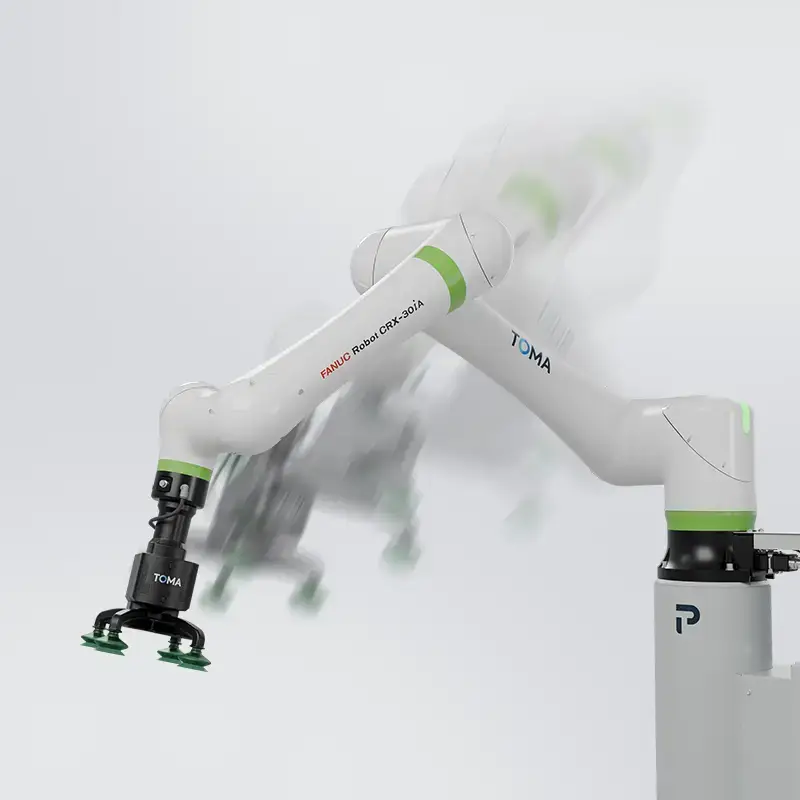
TOMA™ Palletizer uses gentle arm motion in standby and gradual acceleration to make behavior predictable and reduce contact force.
Built-in Speed and Force Limits
Default thresholds prevent injuries from fast or heavy movements.
TOMA™ operates at a verified collaborative speed of 650 mm/s. When equipped with the FLX-0830 safety kit, the system can run up to 1000 mm/s and automatically slows back to 650 mm/s when access is detected.
Safety-Rated Monitored Stop (SRMS)
The system pauses when someone enters a shared workspace.
TOMA™ Palletizer uses three DCS safety zones that slow movement near sensitive areas and stop completely around the operator screen.
Visual Safety Indicators
LEDs signal motion and system status.
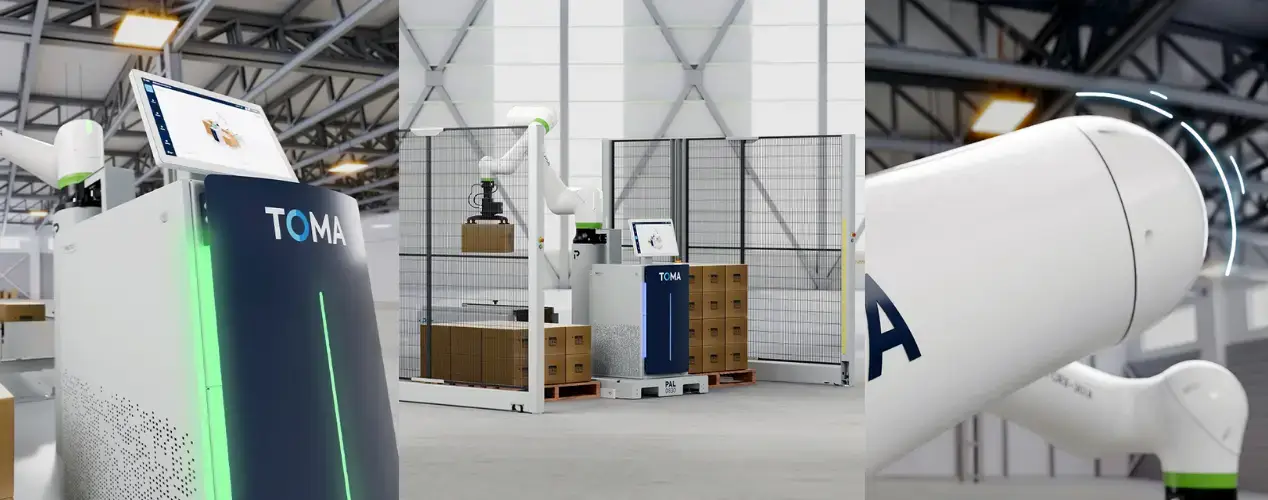
TOMA™ Palletizer combines LED indicators with the MOVN™ interface so operators always know if the system is active, paused, or in standby.
User-Focused Design
Clear documentation and intuitive controls reduce setup errors and operational mistakes.
TOMA™ Palletizer provides guided training, clear manuals, and the MOVN™ interface with step-by-step prompts to simplify operation.
Physical Safety Features
Design elements minimize injury risk during incidental contact.
TOMA™ Palletizer uses rounded edges and smooth layouts to reduce pinch points across all contact surfaces.
Together, these features meet ISO 10218:2025 standards.
When Collaborative Operation Works Without Extra Guarding
In low-risk applications running within safety-rated limits, collaborative palletizing can operate safely without additional physical barriers. The built-in safety features provide adequate protection when the risk assessment confirms it.
When Additional Safeguards Are Needed
When speeds increase or loads get heavier, the risk goes up.
Additional protection may be needed through:
- Area scanners that detect when someone enters a zone
- Light curtains that create virtual barriers
- Reduced speed zones where motion slows automatically
- Physical fencing or barriers around high-risk areas
The right combination depends on your specific application. What's safe for one facility might not be safe for another, even with identical equipment.
How TOMA™ Addresses These Decisions
TOMA™ helps you work through these considerations early in the process. The application assessment identifies where the standard configuration provides adequate protection and where extra safeguards are required.
This isn't about selling you more equipment. It's about making sure the system works safely in your facility before it goes live.
Safety Is Application-Specific
The safest palletizing system is one designed for your specific layout, validated through proper risk assessment, and operated by trained personnel who understand both the technology and the procedures.
A certified robot doesn't guarantee safety. An application that accounts for your facility's layout, workflows, and people does.
Evaluate Your Current Setup
Now is a good time to step back and review:
- Are risks clearly identified for your specific facility and workflows?
- Are operators trained and confident in safety procedures and emergency responses?
- Is equipment configured to minimize hazards while maintaining productivity?
Safety isn't something you achieve once and forget. It's an ongoing conversation between people, machines, and processes. Regular assessment, training updates, and procedural reviews keep that conversation going.
How TOMA™ Supports Your Safety Goals
Every TOMA™ Palletizer from Premier Tech is developed and validated under ISO 10218:2025. The systems combine safety-focused engineering with intuitive controls and expert support throughout implementation.
But compliance at the factory is just the starting point. Real safety happens when the system fits your application and your team knows how to use it properly.
Talk to a Premier Tech expert to see how TOMA™ can support your palletizing and safety goals.
Frequently asked questions
Safety depends on how the system is set up and used in your facility. When properly configured, assessed, and operated by trained personnel, robotic palletizers significantly reduce manual strain and injury risk.
Entanglement, crushing, impact from dropped loads, and ejection from vacuum failure. These usually happen when clearing jams, changing pallets, or performing maintenance.
It depends on your application. Collaborative applications can operate safely without physical barriers at lower speeds. Higher speeds or heavier loads may need area scanners, light curtains, or fencing. Your risk assessment determines what's needed.
A risk assessment evaluates your specific layout and workflows to identify where people and machines could cross paths. It's required by ISO 10218:2025 before the system goes live and determines what safeguards your facility needs.
Yes. Operators, maintenance staff, and supervisors need to understand system behavior, safety zones, and emergency responses. Training should be refreshed when procedures change or new staff join.
Interested in the power of cobots?
Premier Tech’s latest offering, TOMA™, is all about making automation friendustrial™. Head over to our TOMA™ Palletizer page to learn more.