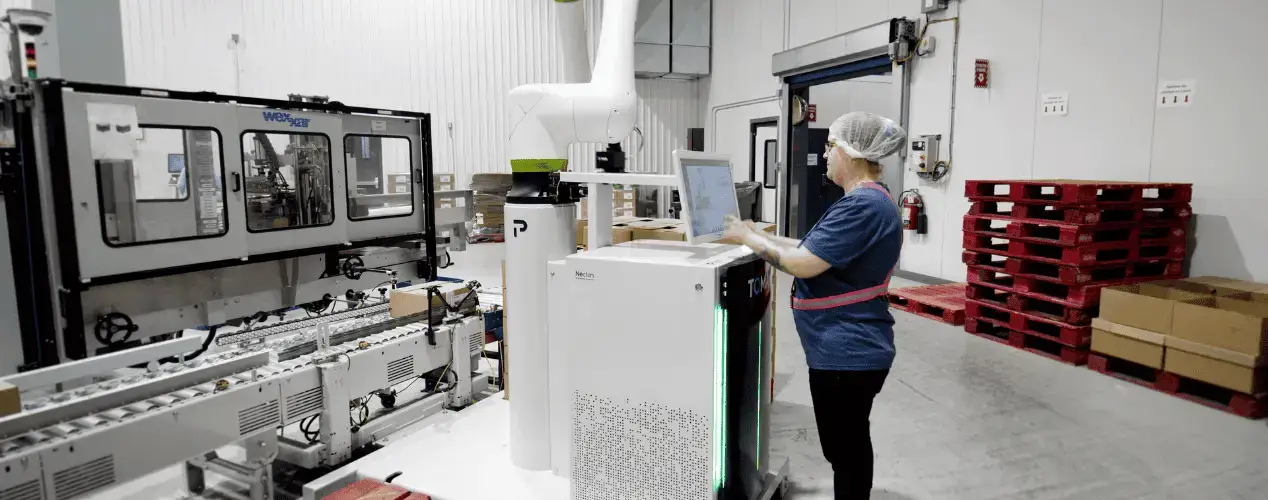
Workforce shortage and cobots: turning a global challenge into a human opportunity
Cobot
Cobots are helping manufacturers face a global labor shortage by taking over repetitive, heavy tasks and freeing people for higher‑value work. This article explains why the challenge is structural—and how solutions like TOMA™ can support teams in their plants.
Across the world, and especially in North America, companies are all running into the same wall: they simply can’t find enough people. The work is there, the demand is there, but the people are not always there to do it.
In US manufacturing alone, the sector contributed about $2.90 trillion to the economy on an annualized basis in the first quarter of 2025 and employed nearly 13 million workers as of August 2025 (National Association of Manufacturers). Yet many of those companies still struggle to fill open positions, and projections suggest that millions of roles could remain unfilled in the coming years, with a massive impact on growth and competitiveness.
This article looks at why this labor shortage is happening, what it means for teams on the ground, and how collaborative robots – cobots – can help. Not as a cold, futuristic replacement for humans, but as practical, reliable teammates that take care of the repetitive, heavy work so people can focus on what they do best.
The workforce shortage: a global issue with local impacts
Walk into almost any manufacturing plant or warehouse in North America and you’ll hear the same story: open positions that stay vacant for months, overtime that becomes the norm, and managers who say, “If I could hire five more people tomorrow, I would.”
This is not just a short-term cycle. Several deep trends are converging.
On the demographic side, populations are aging. In US manufacturing, close to one in four workers is over 55, and the large Baby Boomer cohort is moving into retirement (Manufacturing Today). Another useful metric is the ratio of retirees to unemployed new entrants to the labor force (people looking for their first job). Between 1970 and 2010, that ratio was roughly 1‑to‑1. Since 2010, however, Baby Boomer retirements have pushed it close to 3‑to‑1. There simply aren’t enough younger workers coming in behind them to replace that experience and capacity (Royal Bank of Canada).
At the same time, some jobs are objectively hard to fill. Positions that are physically demanding, highly repetitive, or located away from large urban centers struggle to attract candidates. Even when wages are competitive, many people choose roles that feel safer, more flexible, or less physically intense. During and after the pandemic, a lot of workers moved toward logistics, retail, and e‑commerce jobs that offered reasonable pay without the same level of physical effort.
Expectations are also shifting. Team members increasingly care about work–life balance, physical and mental health, and having work that feels meaningful. A job that looks like “lifting heavy boxes all day” or “doing the exact same motion thousands of times” is a tough sell for younger generations, even when companies offer solid salaries and benefits.
Public policy plays a role too. In the US, industrial policy is encouraging more local manufacturing and reshoring, while immigration and visa rules limit part of the potential workforce, especially for industrial and technical roles. So, we are building more production capacity, but we’re not expanding the pool of available people at the same speed.
All of this shows up clearly in specific sectors:
- Manufacturing and logistics struggle to find enough operators, packers, and material handlers.
- Agriculture and food production fight every season to recruit workers for short, intense periods of physical work.
- Technical roles in automation, robotics, and maintenance are in high demand, but there’s a clear skills gap.
The impact inside companies is very concrete. Existing team members carry more tasks and more responsibility. Projects slip because there aren’t enough hands to install, test, or ramp up new lines. Continuous improvement and innovation are pushed to the side because everyone is already at 100% just to get products out the door.
What starts as a staffing problem on the shop floor quickly turns into a strategic risk for entire economies.
In short, the problem is not that the work disappeared. The work is there. It’s the people who are missing.
So, what exactly is a cobot?
Before going deeper into solutions, it’s worth clarifying what we mean by a cobot.
A cobot – short for “collaborative robot” – is a robot designed from the start to work with humans, in direct proximity, often sharing the same workspace. That alone makes it very different from many traditional industrial robots, which are usually placed behind fences, in closed cells, separated from people for safety reasons.
Cobots are built to be more flexible and adaptable. They can typically be reconfigured more easily, redeployed to new tasks, and integrated into existing lines without completely redesigning the whole layout. They’re designed to be safe to operate near humans when they are properly installed, configured, and risk-assessed, with features like force limits and advanced sensors.
Programming is also more accessible. Instead of writing complex code from scratch, operators can often move the cobot arm by hand to “teach” it a motion, or use simpler interfaces to define tasks. That doesn’t mean no expertise is needed, but it lowers the barrier to entry compared to many older generations of robots.
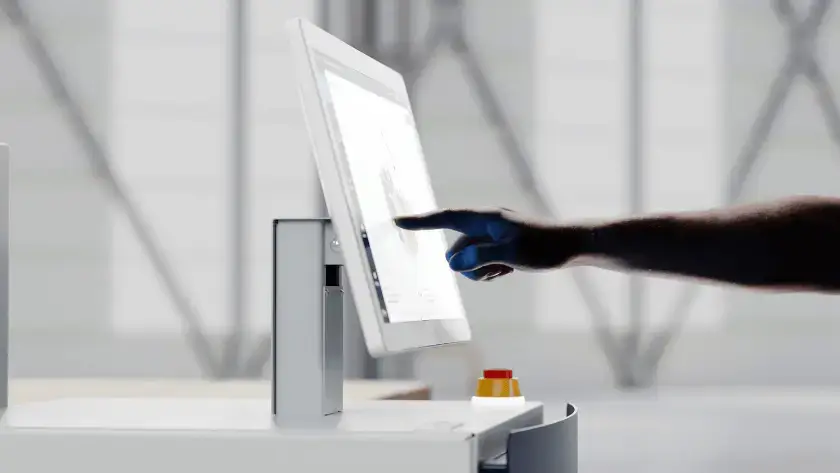
In practice, cobots are used on very concrete, very down-to-earth tasks: stacking boxes on pallets at the end of a line, picking and placing parts, handling repetitive assembly steps, loading and unloading machines, or performing the same quality check hundreds or thousands of times per shift.
This type of work is exactly where automation has the most potential. A McKinsey Global Institute study on the future of work estimated that up to 78% of the time spent on “predictable physical work” activities – like lifting, moving, or routine handling – could be automated using technologies that already exist today. Cobots live right in that space: they are built to take over those predictable, heavy, repetitive motions.
If you strip away all the technical vocabulary, the idea is simple: cobots take over the repetitive, heavy, or ergonomically difficult parts of a job, so that human team members can focus their time and energy on what humans are truly good at – noticing exceptions, solving problems, coordinating, improving, and caring for customers and colleagues.
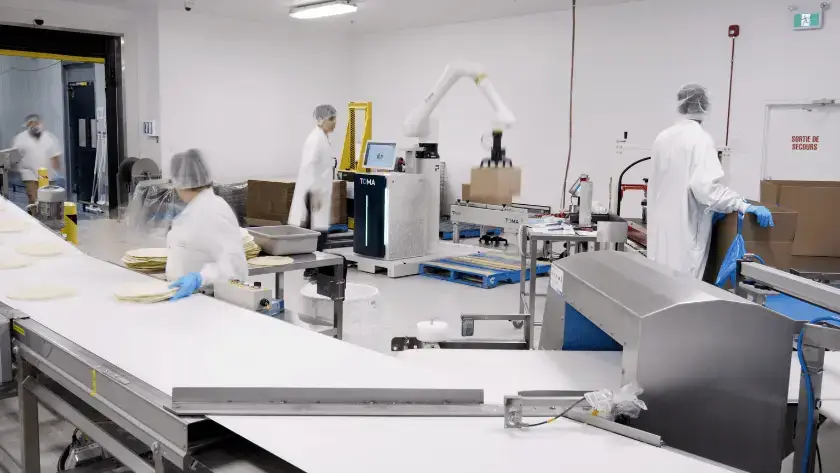
This is exactly the spirit behind cobot solutions like TOMA™: a robot that’s not hidden in a cage, but that stands next to your team, doing the lifting and stacking work reliably, shift after shift.
If you’re just starting to explore this topic and want to go a bit further, take a look at our article “What are the differences between a robot and a cobot: a beginner’s guide.” It’s a simple way to get comfortable with the basics before diving deeper into use cases.
How cobots help address the workforce shortage
Cobots are not a magic fix. They won’t suddenly remove every staffing problem, and they certainly won’t replace the need for people. But in a context where there is more work than workers, they can play a powerful, very practical role.
One way to see them is as a capacity multiplier: for every team member on a line, a cobot can take over a share of the physical, repetitive tasks, allowing that person to cover more ground, handle more value-added tasks, or supervise multiple operations.
In many plants and warehouses, supervisors say the same thing: “If I had more people, I wouldn’t even be thinking about automation.” But the reality is they don’t have more people, and they won’t magically appear. That’s exactly where cobots become relevant.
They help fill roles that are almost impossible to keep staffed, like end‑of‑line palletizing on night shifts. They provide stable, predictable output on tasks that are otherwise very hard on the body. During seasonal peaks, for example in agriculture or consumer goods, they help absorb the extra volume without relying entirely on temporary labor that may not be available.
As one forewoman at Groupe TAQ put it:
“On the night shift, we have fewer team members, so the TOMA™ Palletizer allows us to reassign the three operators previously dedicated to palletizing to the second production line instead.”
Another important aspect is job attractiveness. A role that used to mean “lifting 15 kg boxes all day” becomes much more appealing when a packaging cell equipped with a TOMA™ solution does the lifting, and the human role focuses on supervising the system, handling exceptions, checking labels, and coordinating with the rest of the flow. For younger team members, working with modern technology, learning how to interact with a cobot, and gaining skills they can reuse later is a strong motivator.
Cobots also support consistency and quality. When teams are understaffed, even the most experienced team members can get tired, rushed, or distracted. Mistakes happen. A cobot, on the other hand, will perform the same motion the same way, thousands of times. That doesn’t remove the need for human judgment – it frees people to use that judgment where it really adds value: visual inspections, final decisions, problem-solving, and continuous improvement.
Finally, cobots strengthen long-term resilience. Labor shortages, aging workforces, tighter immigration, changing expectations… none of these will disappear tomorrow. Relying only on hiring is risky. By integrating cobots into key processes now, companies can secure part of their capacity, reduce the dependency on single individuals for critical repetitive tasks, and plan growth with a clearer picture of what is realistically achievable.
In that sense, cobots are not just tools to “do more with less.” They are a way to keep delivering, keep growing, and keep protecting jobs in a world where people are the most limited resource.
What we can learn from countries that embrace robots
If we look beyond North America, some countries offer a preview of what happens when robots – including cobots – are widely adopted in response to challenges involving labor and competitiveness.
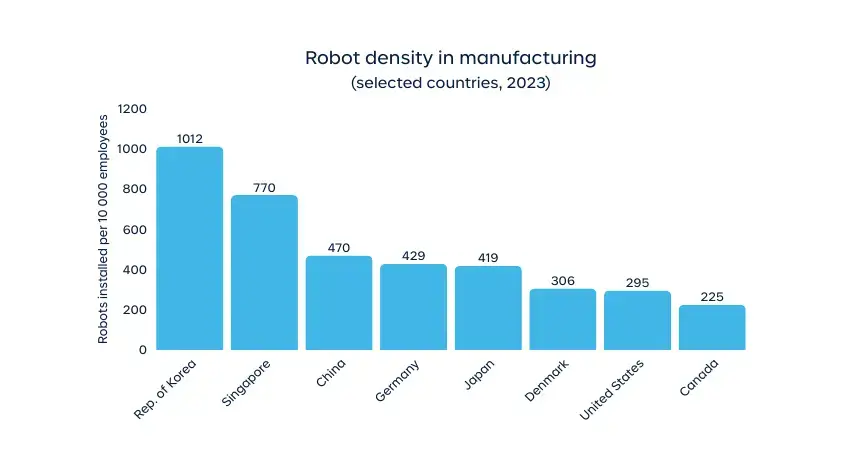
Denmark is a good example. It has one of the highest robot densities in the world outside of the big car-producing nations. According to the World Robotics report from the International Federation of Robotics, the global average robot density reached 162 robots per 10,000 employees in 2023, more than double the level of just a few years ago. The European Union sits at around 219 robots per 10,000 employees, and Denmark is even higher at about 306. In other words, Danish manufacturers have embraced robots and cobots as a normal part of how they stay productive and competitive with a limited labor pool. In many Danish factories, working with automation is simply part of everyday life, not a distant, experimental concept.
This rapid automation is not only driven by technology enthusiasm, it’s also a direct response to high labor costs, limited available workforce, and a strong focus on productivity. Denmark is consistently ranked among the most productive countries globally. Robots and cobots help Danish companies stay competitive, keep production local, and offer good working conditions despite a relatively small labor pool.
South Korea goes even further. It leads the world in robot density, with more than 1,000 robots per 10,000 workers in manufacturing – several times the global average, and more than double a highly industrialized country like Germany. Part of the motivation is similar: an aging population, low birth rates, and a clear need to maintain production capacity and competitiveness.
The interesting part is that in these countries, automation goes hand in hand with a shift in the kinds of jobs people do. As more routine, highly repetitive tasks are automated, the demand for technical, engineering, and maintenance roles grows. Workers need new skills in robotics, automation, and data, and there is a strong focus on retraining and upskilling to help them transition.
These examples matter far beyond their own borders, because they show that:
- High levels of automation can coexist with strong manufacturing sectors.
- Robots and cobots can be used to counter demographic trends, not only to cut costs.
- The real challenge is not “robots vs. humans,” but how fast we can train and support people to work with these technologies.
Cobots fit that philosophy: they bring automation closer to people, not further away, and they’re designed to be understandable and operable by the very team members they support. The TOMA™ product line is built in the same spirit, accelerating packaging automation projects through a comprehensive and intuitive do‑it‑yourself experience – delivering automation that is truly Friendustrial™.
“Will robots take our jobs?” A legitimate question
Every time automation and robots are mentioned, a very human worry appears: “Are these machines going to replace us?”
The concern is real, and it deserves more than a quick “don’t worry.” History shows that technology does change jobs. Some tasks disappear, new ones appear, and many roles are transformed.
But it’s important to look at the current context. In North American manufacturing and logistics today, the main problem is not a lack of work. It’s a lack of people. Plants have more orders than they can fully serve. Production lines can’t run at full capacity because there aren’t enough team members for every shift. Over the 2024–2033 period, the net need for new employees in US manufacturing is estimated at around 3.8 million roles, and if the skills gap and the lack of applicants are not addressed, about 1.9 million of these positions could remain unfilled – a clear sign that the constraint is talent, not demand (Deloitte).
In this context, cobots are not stepping in to push humans out. They are stepping in to keep lines running, to prevent burnout, and to maintain competitiveness so that the jobs that do exist can stay local and stable.
Cobots don’t eliminate the need for humans; they change and often improve the nature of the work. Instead of spending eight hours only lifting, stacking, or repeating the same motion, team members increasingly:
- supervise one or several cobots;
- handle changes and exceptions;
- participate in improving the process;
- perform tasks that require coordination, empathy, or creativity.
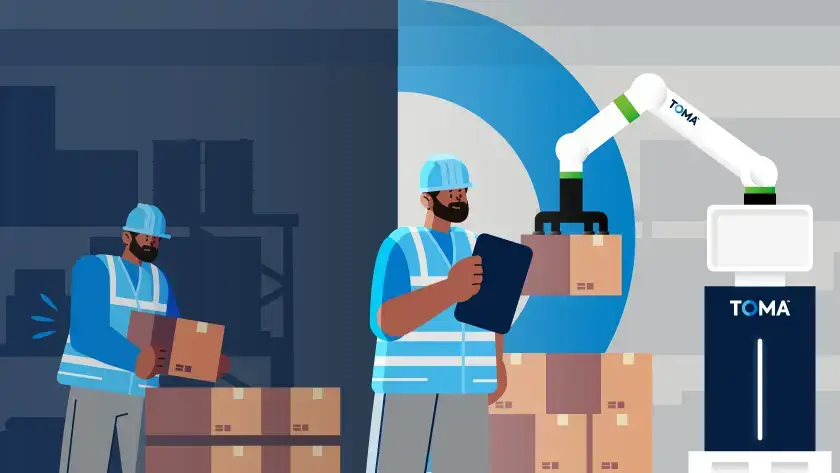
Instead of lifting every box by hand, the operator supervises the cobot that does the heavy, repetitive work.
New roles also appear around them: configuring and programming cobots, maintaining and troubleshooting automated cells, analyzing data to refine performance, training others on how to work with these tools. These are not science-fiction jobs. They are already here in many plants, and solutions like TOMA™ are purposely designed to make that transition accessible, not reserved only for a small group of experts.
The crucial point is how the transition is managed. If a cobot simply appears on the shop floor with no explanation, little training, and no involvement of the team, it’s normal for people to feel threatened. On the other hand, if operators are part of the decision, if they see clearly which pain points the cobot is addressing, and if they are trained and supported to grow with the new technology, the perception shifts. The cobot stops being a competitor and becomes exactly what it should be: a strong, tireless teammate.
Looking ahead: humans and cobots, side by side
The current labor shortage is forcing organizations to rethink how work is organized, how teams are supported, and how technology can help. Around the world, countries like South Korea, Denmark, and Germany have embraced automation with far more robots per worker than the global average. Yet they continue to create skilled jobs in robotics, programming, and maintenance. Jobs are not simply disappearing; they are evolving.
North America is following its own path. For many companies, the goal is not to automate “because it’s modern,” but to stay competitive, protect their workforce, and keep production close to their markets while facing a structural shortage of labor. Doing nothing is no longer an option. The real question is how to use automation in a way that supports team members instead of replacing them.
This is where cobots – and practical, easy‑to‑deploy solutions like TOMA™ – truly make sense. They help close the gap between the amount of work that needs to be done and the number of people available to do it. They free human team members to focus on what only humans can do: creating, deciding, adapting, collaborating, and caring. They also contribute to safer, more sustainable and more engaging jobs, especially in physically demanding environments.
In the end, the ambition is simple and deeply human: not to replace team members with machines, but to give them better tools so they can thrive, even when talent is scarce.
Frequently asked questions
A traditional industrial robot usually works in a fenced cell, away from people, and is optimized for speed and volume. A cobot is designed to work safely near humans, with easier programming, more flexibility, and built‑in safety features. For a deeper dive, you can read “What are the differences between a robot and a cobot: a beginner’s guide.”
Cobots work very well in small and mid‑sized plants. They don’t require a full robotics department and can often be added to existing lines. Many manufacturers start with a single repetitive task, for example with a solution like TOMA, prove the benefits, then scale.
Cobots are ideal for predictable, repetitive and physically demanding tasks: palletizing, box handling, simple pick‑and‑place, machine loading, basic quality checks. If a job involves doing the same motion all day, especially with weight or awkward posture, it’s a strong candidate for a cobot.
Cobots fill roles that are hard to staff, improve ergonomics so jobs are more attractive, and help secure capacity when hiring is difficult. They don’t just make each cycle faster – they make it possible to keep lines running even when you can’t find enough people.
Cobots include safety features like force and speed limits, but safety comes from the full setup: risk assessment, layout, and procedures. When a cobot like TOMA is properly integrated, it can work safely beside team members and take over the heavy, repetitive motions.
Not necessarily. Cobots are designed to be more user‑friendly than traditional robots.
Premier Tech and its partners can handle design and integration, while your team learns to operate and adjust the system with targeted training.
Share with your socials
Looking for something simple and code-free?
TOMA™ is all about making automation friendustrial™, and our team has made the power of cobots accessible in an all-new way. Learn more about our products.
