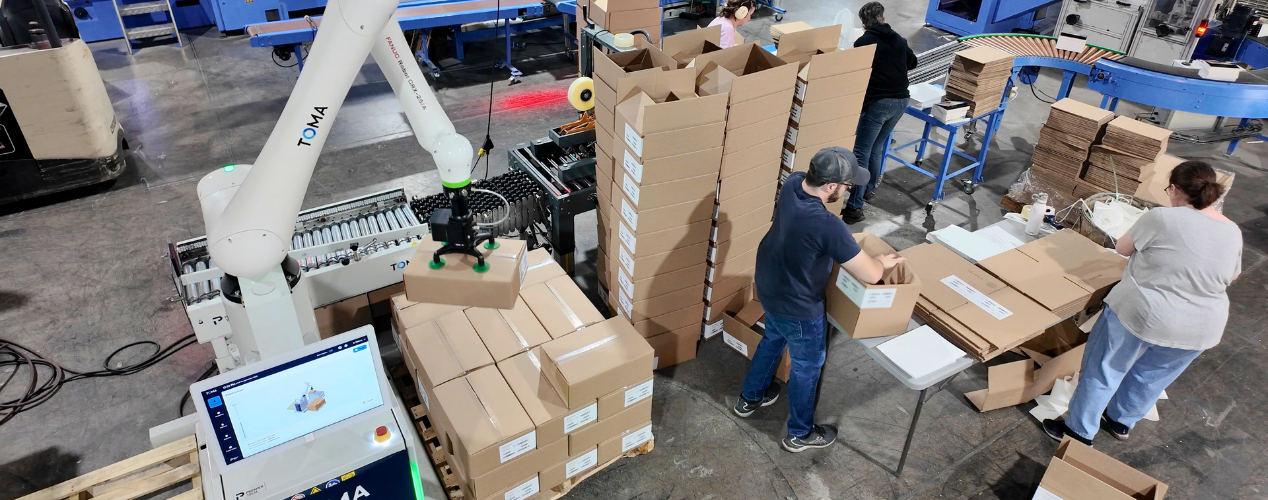
How is a cobot palletizer different from a traditional robotic palletizer?
Modern cobot palletizers are changing how manufacturers think about safety. This article explores how collaborative palletizing reduces ergonomic risk, fits tighter spaces, and helps create safer, more flexible production environments.
For many manufacturers, automation has long been associated with large industrial robots, safety fencing, and dedicated work zones that separate people from machines. In facilities with limited space, strict food safety standards, high employee traffic, or limited robotics expertise, robotic palletizing has often seemed difficult to implement safely, if not too risky to consider.
But collaborative palletizing has changed that equation.
Today’s cobot palletizers are designed to operate more safely around people, fit more easily into real production environments, and reduce the ergonomic and operational risks associated with repetitive manual palletizing.
As a result, a clear shift is happening across manufacturing industries. Manufacturers are no longer asking, “Is automation dangerous?” They are asking, “How much risk are we still accepting by continuing to palletize manually?”
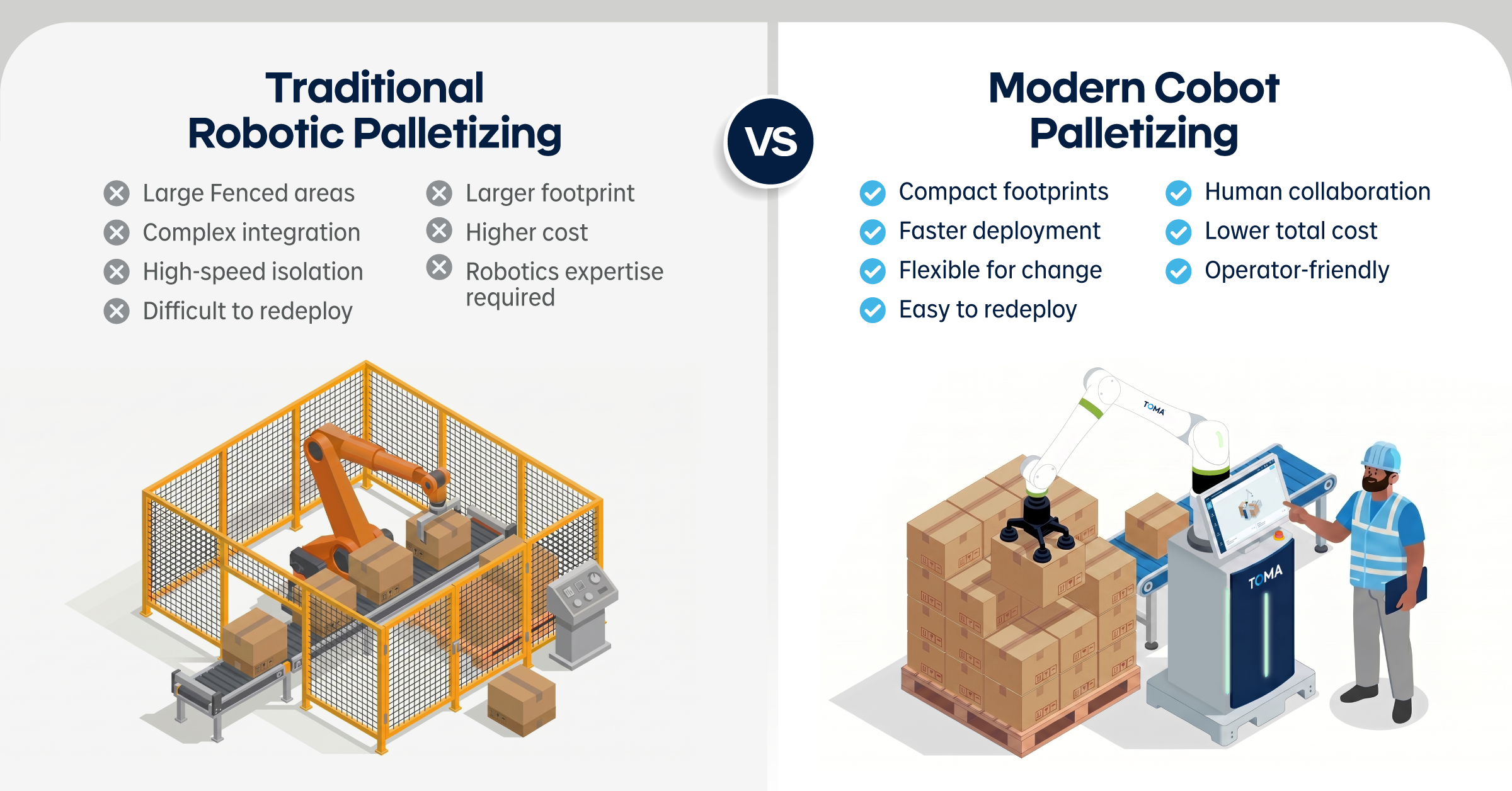
Historically, industrial robots were designed for one thing: Maximum speed and throughput.
That made them extremely effective for high-volume manufacturing, but it also required strict separation between humans and machines.
Traditional robotic palletizers often needed:
For many manufacturers, especially small and mid-sized operations, this created real barriers to adoption.
The environment itself became the objection:
In some facilities, those concerns were justified. But collaborative robotics introduced a fundamentally different approach.
A collaborative robot, or cobot, is specifically designed to operate in closer proximity to people than traditional industrial robots. These systems often include built-in safety features intended to support safer human-robot interaction, depending on the application and risk assessment. (FANUC)
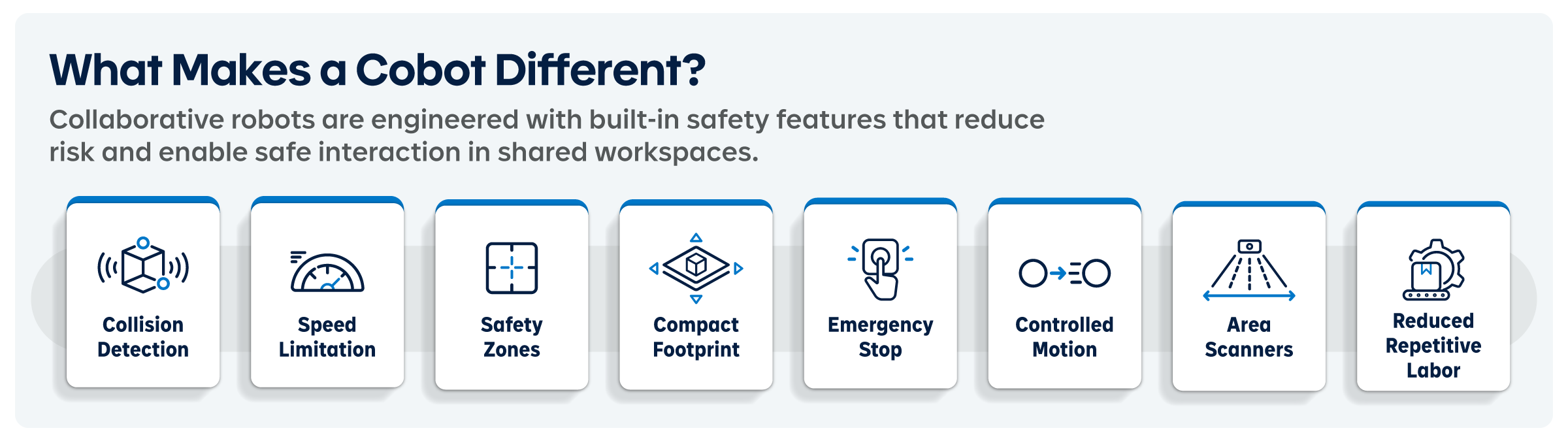
Many systems also integrate advanced safety scanners and area monitoring technologies that automatically slow or stop robot motion when a person enters a designated zone.
Instead of isolating humans from automation entirely, collaborative palletizing systems are built around safe interaction.
That distinction matters.
Because in most real-world manufacturing environments, people and machines already coexist constantly. The goal is no longer simply separation. The goal is risk reduction.
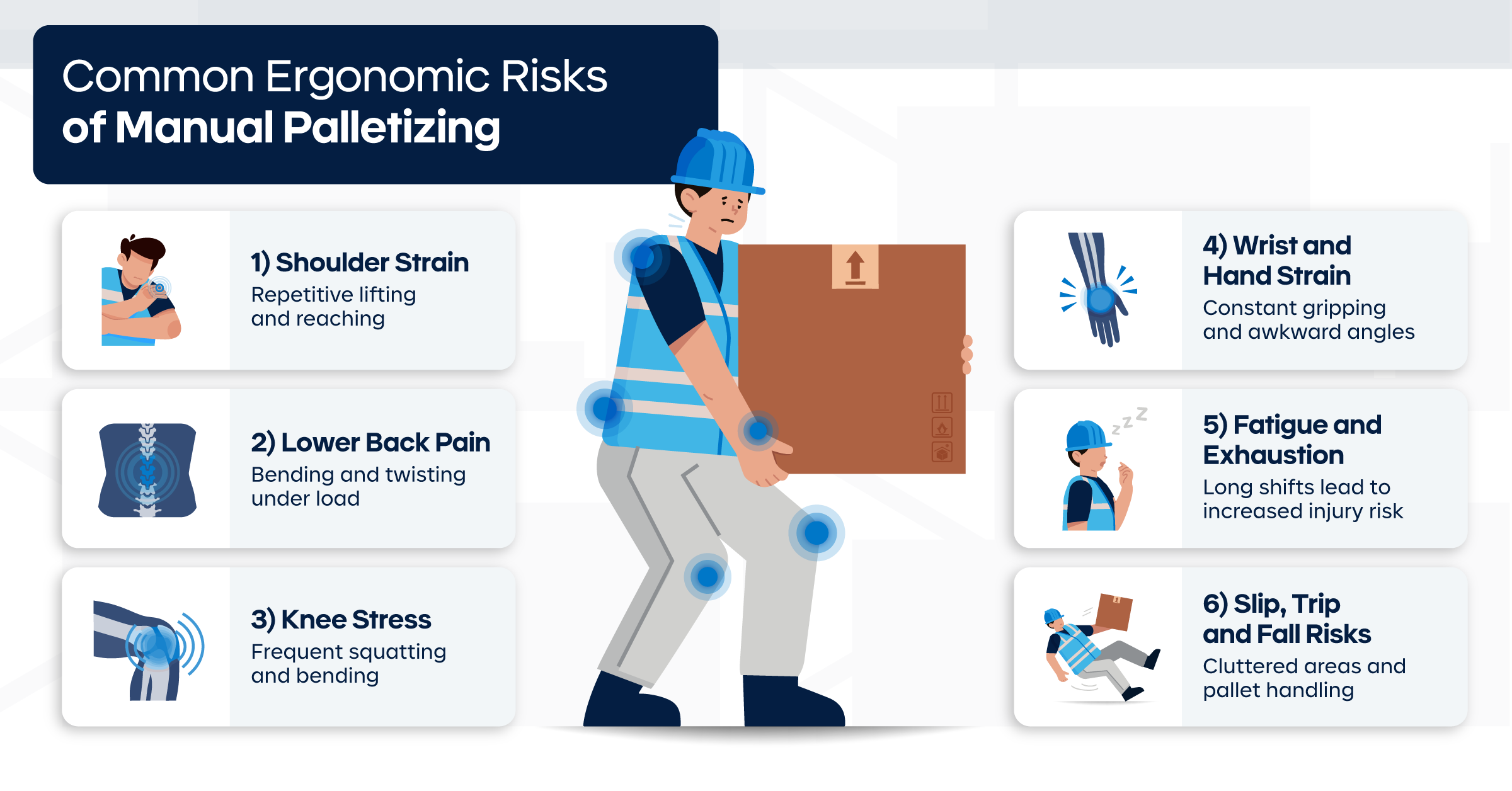
One of the biggest misconceptions in manufacturing automation is that manual palletizing is somehow the “safer” option because there’s no robot involved. But repetitive palletizing tasks create their own major workplace risks.
These often include:
Palletizing is physically demanding, repetitive, and difficult to sustain over time, especially in facilities running multiple shifts. Collaborative palletizing changes the nature of the operator’s role.
Instead of performing constant repetitive lifting, employees can shift toward:
In many facilities, automation is becoming less about replacing workers and more about reducing the physical wear associated with difficult manual tasks.
Modern robot safety standards have evolved significantly alongside collaborative robotics. Standards such as ISO 10218 helped establish frameworks specifically addressing collaborative robotic applications and risk assessments.
But an important detail is often overlooked: A cobot is not automatically “safe” simply because it is collaborative.
Safety depends on the entire application.
That includes:
For example, a collaborative robot moving lightweight cartons behaves very differently than one handling sharp metal parts. That’s why proper integration matters.
The safest cobot palletizing systems are designed with the production environment in mind from the beginning, not added as an afterthought.
Ironically, some of the environments that once avoided automation are now among the fastest adopters of collaborative palletizing. Why?
Unlike large traditional palletizers, collaborative systems often require significantly less floor space and can be redeployed more easily as production needs evolve.
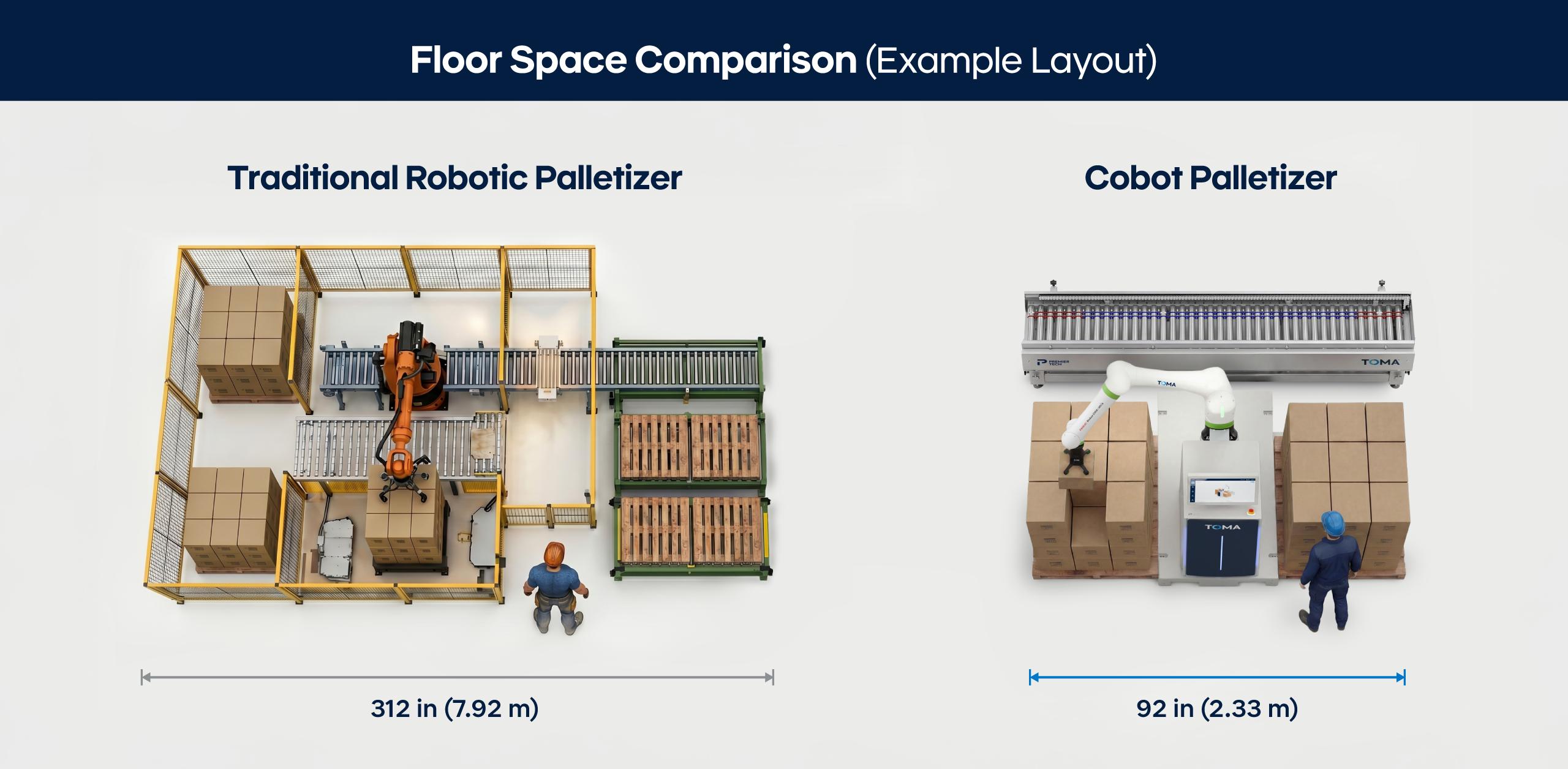
For manufacturers facing labor shortages, increasing safety expectations, and rising throughput demands, the flexibility of collaborative automation is becoming a major advantage.
There’s another reason cobot safety matters: Employee acceptance.
Many workers initially feel uncertain around automation. Large industrial robots can appear intimidating, especially for teams unfamiliar with robotics.
In many facilities, this reduces resistance to automation adoption and helps operators become comfortable with the technology more quickly.
The goal isn’t to create a “robot-only” environment. It’s to create a safer, more sustainable workflow for the people already doing the job.
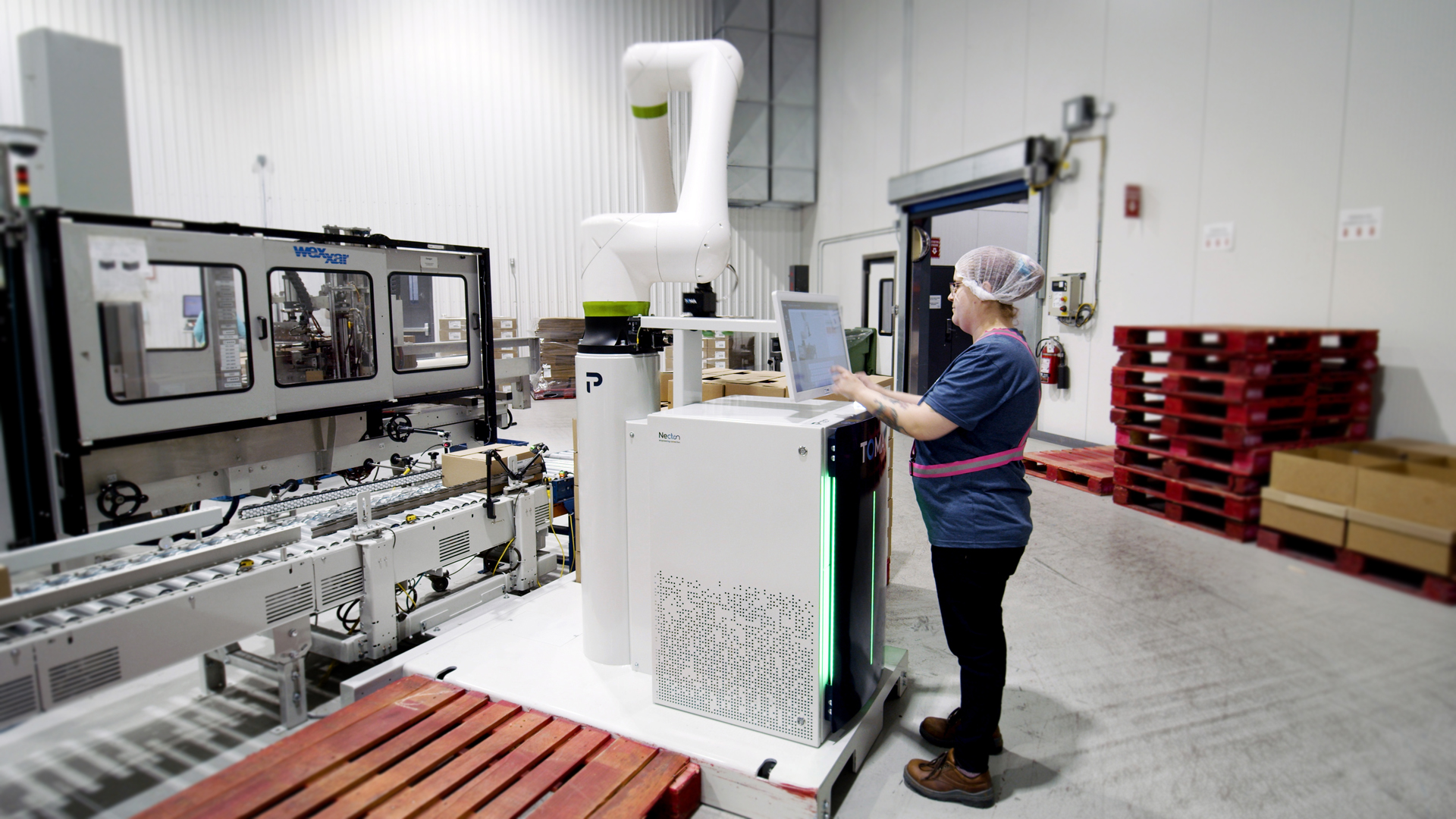
As collaborative robotics continue evolving, safety is becoming more intelligent, adaptive, and integrated directly into manufacturing operations.
Emerging developments include:
Organizations are increasingly focusing on how humans and robots can safely share production spaces without sacrificing operational efficiency.
The conversation is no longer about whether humans and robots can work together.
It’s about how to make that collaboration safer, smarter, and easier to deploy.
For years, manufacturers viewed automation as something that introduced risk into the workplace.
But many are now realizing the opposite may be true. The repetitive, physically demanding nature of manual palletizing already carries significant operational and ergonomic risk. Collaborative palletizing doesn’t eliminate safety concerns entirely, no industrial equipment can. But modern cobot systems are fundamentally changing how manufacturers think about safety, workforce sustainability, and operational flexibility.
The “dancing robot” perception is slowly being replaced by something more practical: Automation designed around people, not separated from them.
